


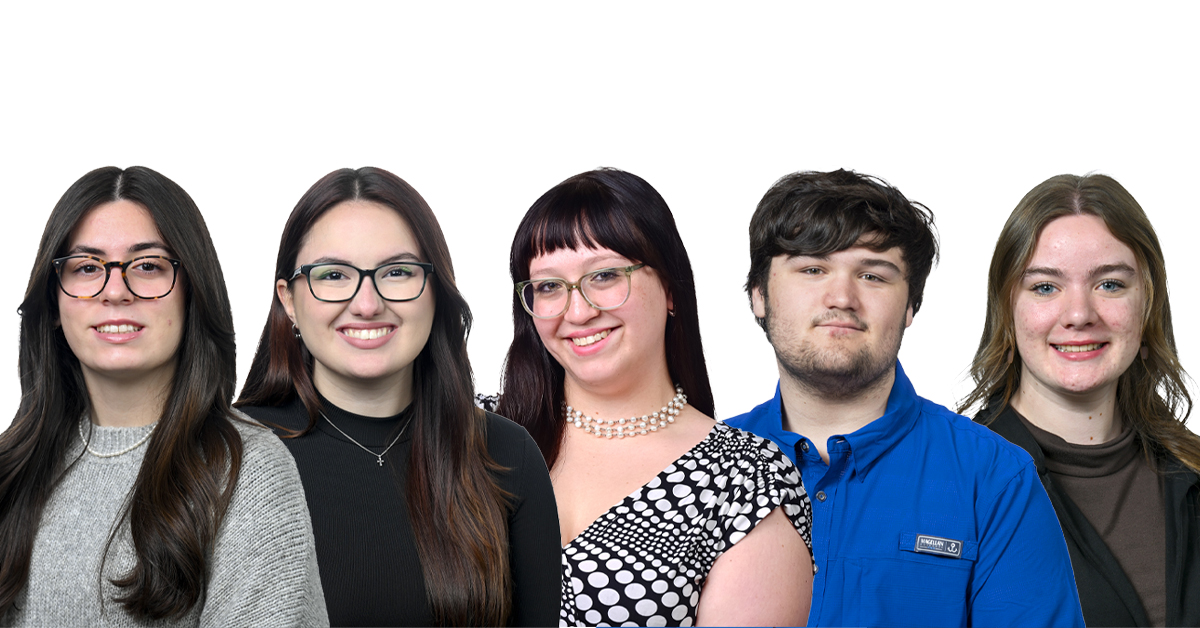
Five Louisiana Tech students have been nominated to the Goldwater Scholar Competition, a highly selective, national scholarship awarded by the federal government to the top undergraduate researchers in various STEM fields.
Tech’s five nominees are Caitlyn Boudreaux, Allie Buchanan, Aurora McCain, Joshua Robinson, and Bryleigh Wickham.
Universities can nominate up to four undergraduate students and one additional transfer student. The University nominated the students officially on January 30; National Scholars are announced March 27.
A panel of reviewers narrowed the field of finalists from the 19 Tech students recommended by faculty for the Goldwater. Students worked with Kristi Stake, coordinator of nationally competitive scholarships, to complete the exhaustive applications.
The scholarship is one of the nation’s most respected honors for undergraduates who are pursuing research careers in natural sciences, mathematics, and engineering. It recognizes students with the curiosity, talent, and drive to become the next generation of scientific leaders, those whose work will shape national security, strengthen the country’s global competitiveness, and push the boundaries of knowledge.
“Supporting applicants for this distinguished award highlights Tech’s commitment to helping exceptional students thrive,” Director of Honors College Dr. Joel Stake said. “It strengthens the University’s mission to develop learners and leaders who are ready to take on the complex challenges of today and the future.”
The Barry Goldwater Scholarship and Excellence in Education Foundation was established by Congress in 1986 to serve as a living memorial to honor the lifetime work of soldier-statesman Senator Barry Goldwater; the Foundation has since awarded more than 11,000 scholarships.
Tech’s Goldwater nominees:
Caitlyn Boudreaux
- Junior
- Chemistry
- Advisor: Danny Eddy
- Hometown: Des Allemands
- High School: Hahnville High
- Career Goals: Research on cancer treatment discovery to manufacturing to full patient recovery timeline and success
- Past Research:
- Worked with Dr. Mark Decoster and Kyle Rugg synthesizing copper high-aspect ratio structures (CuHARS)
- Won a Support for Research Excellence (SURE) Grant to continue her research independently
“I became interested in studying biochemistry through my collaboration and companionship
with my research team. While I was motivated by the opportunity to be a part of this
research, my fascination in applying chemical analysis to biological concepts was
solidified by the dedication of the team to the research and their enthusiasm and
support when I first joined.
"In my research, I react various metal salts and amino acids in liquid solutions to synthesize a nanomaterial and test the product with various forms of spectroscopy. The long-term goal is to refine the efficiency at an industrial scale within the hopes of manufacturing to optimize its potential to regenerate blood vessels and utilize anticancer capabilities."
Allie Buchanan
- Sophomore
- Psychology
- Advisor: Dr. Tilman Sheets
- Hometown: Rockwall, Texas
- High School: Rockwall-Heath High
- Career Goals: Become a professor and clinician, conducting research to further the understanding of cognition in relation to human behavior
- Past Research:
- Worked with Dr. Jane Jacobs in the Visual Short-Term Memory and Imagery Lab to study what happens in the brain during the first few seconds of sight.
- Working with Dr. Jane Jacobs to understand how visual impairment influences cross-modal reorganization in the brain.
“My interest in psychology began as a child through the stories my mom shared about
her work as a neuropsychologist. I looked forward to dinner each night just to hear
about a new patient (without compromising HIPAA) and to listen as she walked through
her thought process during their assessment. Although I enjoyed sharing psychology
facts with friends, I did not seriously consider pursuing the field until the end
of my senior year of high school.
"I am currently researching cross-modality and how visual impairment influences cross-modal reorganization in the brain. In simpler terms, I study how the brain uses information from one sense to help understand another sense, which is called cross-modality. For example, many people naturally think of high-pitched sounds as being ‘higher’ in elevation and low-pitched sounds as ‘lower’ in elevation, even though sound does not actually have height. In this case, what we see influences how we hear. Because vision is usually our most dominant sense, it often influences how the brain interprets information from the other senses.
"My research asks what happens when vision is limited or unavailable. I focus on people with visual impairments to understand how their brains adapt and reorganize to make sense of the world using other senses, such as hearing and touch. I do this in the hopes that understanding these changes can lead to better educational approaches and rehabilitation strategies that align with how the brain naturally rewires itself for those who are visually impaired.”
Aurora McCain
- Junior
- Forestry
- Advisor: Dr. Heidi Adams
- Hometown: Argyle, Texas
- High School: Argyle High in Flower Mound
- Career Goals: Conduct research on how genetic variation affects growth and adaptation in southern pines to improve the forest
- Past Research:
- Working with Dr. Joshua Adams, Dr. Gordon Holley, and Dr. Shaoyang Yang studying naturally regenerated loblolly pine stands in the western Gulf Coast
“I study how loblolly pine trees, an important commercial tree species in Louisiana,
grow under different conditions by measuring things like tree size and spacing. I
do this research in hopes that one day it will help landowners and foresters make
informed decisions on how to grow healthy, productive forests that benefit both the
environment and local communities.”
Joshua Robinson
- Sophomore
- Mathematics
- Advisor: Dr. Nathan Green
- Hometown: Haughton
- High School: Airline High in Bossier City
- Career Goals: Contribute extensively to pure mathematics through both novel research and effective university instruction.
- Past Research:
- Working with Dr. Ann Clifton and Dr. Blake Farman investigating the topological properties of Cayley graph embeddings.
“Since Louisiana Tech has a uniquely high number of graph theorists for math faculty,
I became exposed to my topic first through the general courses on Graph Theory. Then,
under the guidance of Dr. Clifton and Dr. Farman, I began exploring the specific area
of Algebraic Graph Theory through a certain structure called Cayley graphs. Cayley
graphs are constructed using algebraic structures called groups. By studying these
Cayley graphs through Graph Theory, we strive to determine information about the algebraic
groups they are based on.
"In practical terms, my research aims to better understand how the structure of certain graphs, Cayley graphs, reflects the algebraic properties of the groups used to construct them.”
Bryleigh Wickham
- Junior (Transfer)
- Biomedical Engineering
- Advisor: Dr. Teresa Murray
- Hometown: West Monroe
- High School: West Ouachita High
- Career Goals: Conduct research in tissue engineering and work in a tissue engineering-focused biotech company
- Past Research:
- Worked with Dr. Elisa Castagnola and Umisha Siwakoti developing glassy carbon microelectrode arrays (GC-MEAs) to use for real-time detection of neurotransmitters in mouse brains.
- Worked with Dr. Jian Zhang and Seth Martin at the University of Arkansas creating a free migration and restricted migration state for fibroblasts to be seeded in using photolithography techniques.
- Won a Louisiana Space Grant Consortium Assistantship to work with Dr. Elisa Castagnola to design and build a reproduceable small-scale centrifuge to simulate hypergravity conditions for university laboratories to conduct space research.
“Growing up, I did not know what an engineer was. I grew up in a place where scientific
careers were not common. My favorite subjects in high school were biology and math,
but I never knew of a career that could combine the two. I was attending a different
university my first year after high school, and I could not find any program that
made me excited about the subject. I discovered an old classmate was studying bioengineering
at her university. I researched the field and instantly knew it was the career for
me. I transferred to Louisiana Tech’s biomedical engineering program and have fallen
in love with the field.
"For my current research project, I am building a small-scale centrifuge for studying hypergravity conditions in common laboratories. Hypergravity is defined as any gravitational force stronger than Earth’s. Astronauts experience periods of hypergravity during takeoff and re-entry of the spacecraft. Reproducing altered gravity states on Earth is difficult due to cost and size restrictions. My project aims to allow common research labs to study effects of hypergravity without breaking the bank. Upon completion of this project, I plan to utilize my centrifuge to study the effects of hypergravity on neurotransmitter levels in the brains of mice. This plan will provide crucial knowledge on the effects of spaceflight and allow scientists to make spaceflight safer and more enjoyable for astronauts.”