


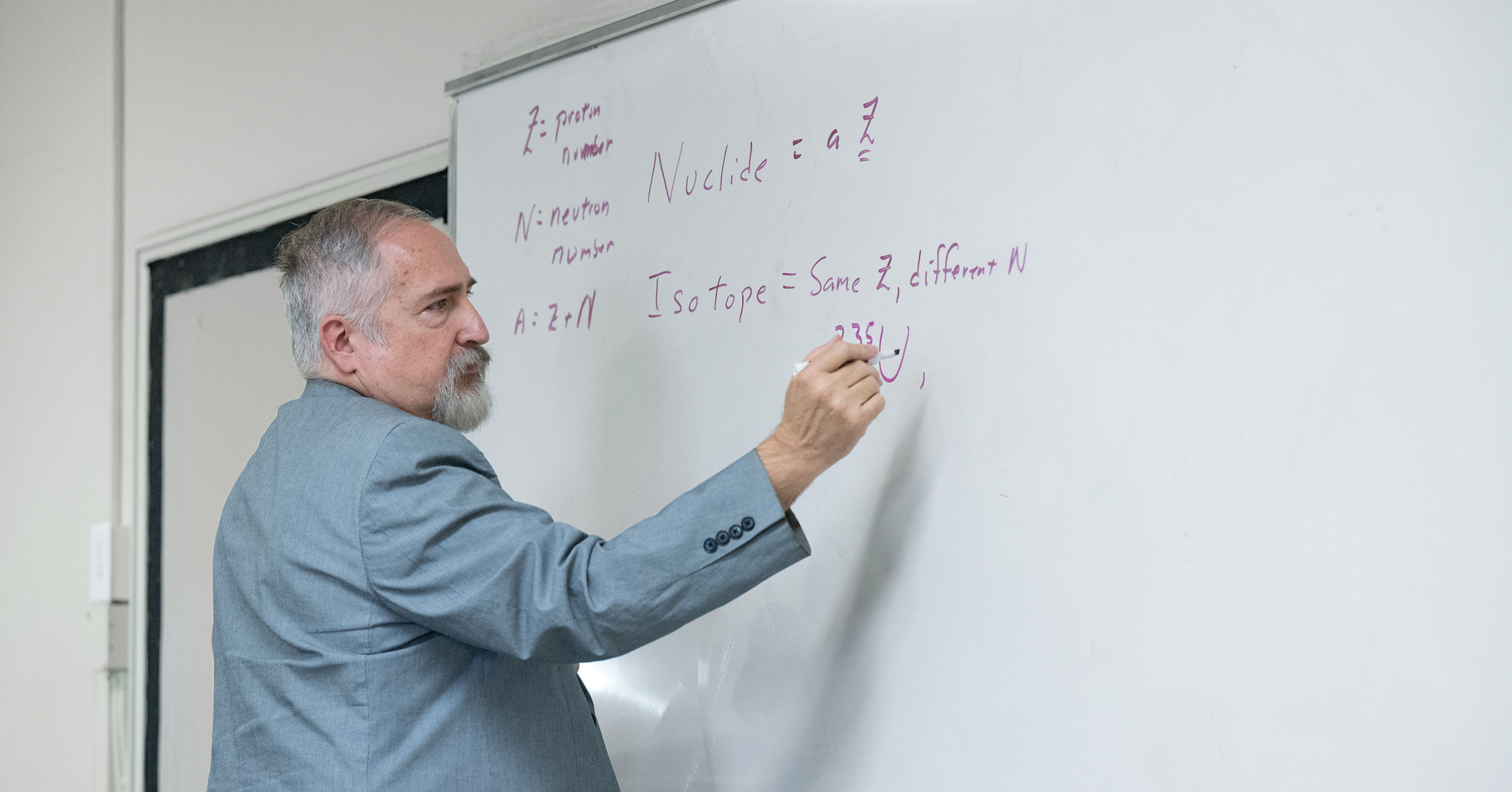
Louisiana Tech University physicist Dr. Lee Sawyer was selected for a prestigious international leadership position within the ATLAS Collaboration at CERN, positioning the University at the forefront of one of the world’s largest scientific research efforts.
Effective October 1, 2026, Sawyer, professor of physics and academic director of physics and chemistry in Louisiana Tech’s College of Engineering and Science, will serve as Jet/ETmiss Combined Performance Convener, a two-year leadership role responsible for overseeing the performance, calibration, and validation of one of the ATLAS detector’s most critical systems.
“Leadership appointments like this are earned through years of scientific excellence and the confidence of an international research community,” Dr. Collin Wick, dean of the College of Engineering and Science, said. “Dr. Sawyer’s selection reflects decades of scientific leadership and Louisiana Tech’s longstanding contribution to one of the world’s most ambitious scientific endeavors. His NSF-supported research program has created exceptional opportunities for our students while strengthening the University’s reputation as a meaningful contributor to international scientific discovery.”
As Jet/ETmiss Combined Performance Convener, Sawyer will coordinate international teams responsible for ensuring the accuracy of detector measurements that support many of ATLAS’ highest-profile physics analyses, including studies of the Higgs boson and searches for previously undiscovered particles.
His appointment comes at a pivotal moment for particle physics. On June 29, CERN concluded the final physics run of the Large Hadron Collider (LHC) before beginning Long Shutdown 3, a four-year international effort to upgrade the accelerator and its experiments for the High-Luminosity Large Hadron Collider (HL-LHC). Scheduled to begin operation in 2030, the upgraded collider will increase the LHC's data-producing capability by up to a factor of ten, enabling unprecedented precision in studying the Higgs boson and expanding the search for physics beyond the Standard Model.
Sawyer was selected through ATLAS’ international nomination and review process, recognizing decades of technical expertise and scientific service within the collaboration. For Sawyer, this involvement places Louisiana Tech among leading research institutions, while also providing students with opportunities to engage in cutting-edge research.
“The value of our involvement places Louisiana Tech in the same conversations as the leading research institutions worldwide,” Sawyer said. “We work closely with colleagues from places such as Stanford, Oxford, the University of Paris, and so on. We provide students at both the undergraduate and graduate level the opportunity to see cutting-edge science and to work with extremely advanced scientific topics in an international context. For over a quarter of a century, the High Energy Physics group has secured external research funding that has supported faculty and students to pursue particle physics research, first at Fermilab near Chicago, and since 2007 at CERN.”
Louisiana Tech’s physics research program provides undergraduate and graduate students with opportunities to contribute to detector operations, artificial intelligence applications in particle physics, and data analysis alongside researchers from leading institutions around the world.
“Working with Dr. Sawyer has taught me a lot about how research is done,” Ryan Boudreaux, fourth year physics major, said. “Contributing to a project of this scale inspires amazement and makes me wonder about what direction science will head.”
“I am extremely grateful for the opportunity to be part of Louisiana Tech’s HEP team and to work with Dr. Sawyer,” Chaisse Benson, third year physics major, added. “I never thought this would be possible as an undergraduate, but I’m looking forward to the doors this experience will open for me as I pursue my Ph.D.”
ATLAS brings together thousands of physicists, engineers, and computing experts that play a critical role in investigating some of the universe’s most fundamental questions, including the nature of dark matter and physics beyond the Standard Model.
“Working with the ATLAS Collaboration at CERN has been an incredibly rewarding experience,” Habeeb Adenle, Ph.D. student in engineering physics, said. “Working under Dr. Sawyer's mentorship has profoundly strengthened my desire to pursue a lifelong career in high-energy physics. These experiences have reinforced my ambition to work in academia and research and development, where I look forward to contributing to future breakthroughs in particle physics and mentoring the next generation of scientists, just as Dr. Sawyer has mentored me.”
As Sawyer prepares to begin his leadership role this fall, Louisiana Tech continues contributing to one of the world’s largest scientific collaborations while providing students with opportunities to engage in internationally recognized research.